Wrapping Up

This week, I begin wrapping up Project Conversation and reflect upon what was learned from its development. Additionally, I discuss my believability metric and progress on conference talk review.
Research Through Design Reflections
With the end of the semester coming near, I figured it's time to finally put a bow on Project Conversation. First however, I wish to reflect upon how far it has come and what insights can be gained. Then next week I will begin to clean it up for dissemination. Finally, I will begin brainstorming what comes next based on the insights this project has provided.
Final Outcome of Phase Two
In the newest phase of the project, we moved away from the old method of a 3D environment where you could walk around and talk to party guests. Now, players play a 2D style visual novel inspired by the navigation system of Stray Gods which allows players to select who they wish to speak to at different points in the evening. During the game, players try to unravel the story’s mystery and learn more about the main character and the world around them.
For my side of things, three core systems ended up being developed
A Gossip System: Tracks the knowledge of each NPC and allows NPCs to share knowledge with one another
A Social Media System: Allows for NPCs to make posts using their knowledge, and other NPCs to reply. Each post and reply is custom made for each NPC but written in an Mad Lib style so that it can be used for multiple types of knowledge
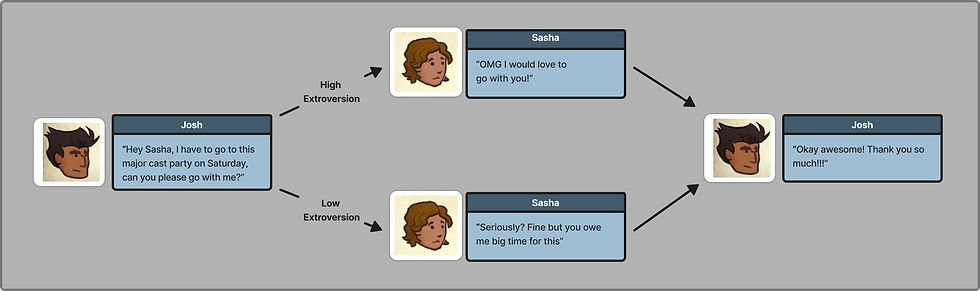
A Story Generation System: Allows for NPCs to perform actions between time steps if not being spoken to by the player. NPCs take actions towards one another and have the ability to take actions that match the current relationship between themselves and the target and that match the initiator's personality
Each system ended up playing a key role in my discoveries but both (2) and (3) still have more room left for development as will be discussed below. Currently, the game itself is in a playable state and does complete the project objective but it ended up revealing two key weaknesses:
The system was not very enjoyable to players nor interesting beyond its novelty
The system was often led to confusion or was ignored
The biggest reason for these issues was likely the game that the game it was being implemented into was not designed to have the systems and thus resulted in them feeling isolated and of low relevance to a player. Additionally, the systems were largely un-interactive so even when used did not provide much interesting gameplay. Thus, this provides the following insights:
Future projects will need to incorporate the systems into their design from the beginning
Future implementations should provide interesting gameplay opportunities for players to increase enjoyment
Future projects would benefit from more early stage testing to validate the systems applicability to the project
Thus it has been decided that the project will not be continued further beyond this semester and the systems will be repurposed for a new project that better integrates them. However, I don’t consider this a failure since many insights were gained and improvements were made since Phase One.
Growth from Previous Phase
In the previous phase of the project discussed back in Back to the Drawing Board, I talked about the insights we had gained from the first phase (P1) of the project. I figured now with this second phase (P2) nearing its completion this week, it would be good to take a look back and see how well this iteration did in improving.
The first major goal of this iteration was to explore how to communicate to the player that the NPCs are gossiping about events in the game. In P1, a common issue encountered was the players not noticing the gossiping was occurring. This was due to the NPCs simply standing near one another when sharing information which players would not link with gossiping when they were focusing on other tasks. To address this issue, a new solution of using a social media system was proposed. Through doing so, it became a lot more obvious to players what was being said and what was not. However, this then led to a new problem area, how do you make players care? More specifically, the social media system essentially became a side piece for the main game resulting in some players not using it and others just feeling more confused after interacting with it. While the problem statement had been completed, the usefulness to the game was still missing. Thus the following questions were raised:
How do you integrate into your game gossip system a gossip system that is immersive, useful, and enjoyable for players?
Who should be transmitting and receiving gossip and do those two groups differ?
How do you allow players to spread gossip and receive gossip and should they?
The second major goal of this iteration was to determine what should be gossiped about. Through exploring this, we were able to determine a gossip data structure that serviced our needs well. However, a new issue arose with this problem statement quickly into development. Specifically, how do you generate enough content for gossip to occur? In our initial approach we would flag dialogue nodes with gossip markers but this resulted in only 1-2 gossipable information per action in our game. Thus, since we only had 4 actions only 4-8 pieces of gossip would be spread for our 8 person cast resulting in it making the social system feel barren rather than active.
Therefore we needed to come up with a new solution that would be able to further supplement the current gossipable information. Additionally however, Rae was preoccupied with the core game story and thus it also needed to use low amounts of narrative bandwidth. Thus, it was decided to create a story generation system that could create this content. Through doing so, it was found that story generation systems actually can tackle multiple different aspects of believability. In particular:
Personality through having unique actions for different NPCs
Socializability through having the actions be between NPCs
Illusion of Life through having the ability to act upon goals
Awareness through being able to react to what actions others have taken and what actions are available in a given situation
However, similar to the social media system, the story generation system also revealed new questions that still need to be answered. In particular:
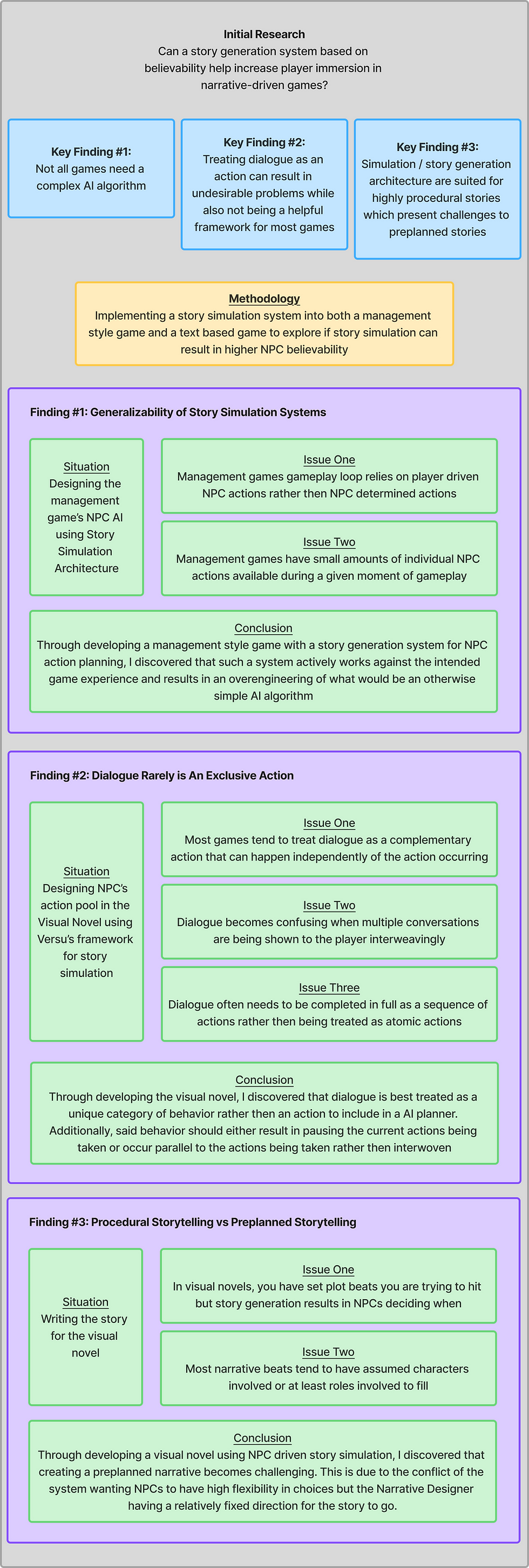
How do you prevent total # of actions needed from becoming exponential per characters, personality types, relationship types, and actions needed? (see last weeks post for more information on this)
How do you produce sequences of actions rather than isolated events in order to tell narrative arcs?
To what level of generality should these events be for background vs side vs main characters?
How do you better involve the player in influencing these actions?
How do you connect said system to the gameplay loop to make it immersive, useful, and enjoyable for players?
How do you make NPCs feel unique when performing generic actions?
Next Steps
Overall, P2 ended up revealing a number of new directions to explore. Most promisingly, it has shifted my focus away from the gossip system with how NPCs transmit information to one another to a story system which determines how NPCs should interact with one another. The reason being is that through doing so I’ll be able to explore more aspects of believability then I had before. Additionally, such a system could have a number of potential use cases such as:
Background NPCs for Open World RPGs
NPCs suspects in a murder mystery / rougelike hybrid where the mystery changes every run
NPC Party Members during camp / break scenes for TTRPGs
NPC actions for visual novels using a storylet approach similar to Johnson-Bey et al (2025)
Thus, the scope of my project now shifts to being on story generation system, believability, and emergent narratives. My next steps will be as follows:
Explore further some of the design questions posed regarding story systems
Begin prototyping a variety of new project ideas that could better benefit from this system
Explore implementing this system into a larger scale version of one of those prototypes to see what new insights can be gained.
Believability Study
Additionally, I wanted to take some time this week to provide some updates on my believability study since it has not received much attention as of late.
Firstly, I’ve decided to narrow my categories down to nine through the removal of appearance. This is because of appearance having overlap with coherence and illusion of life.
Second, my IRB to conduct the study is nearing completion with the final draft aiming to be written by the end of this week.
Third, I’ve now created a survey to evaluate my metric and have compiled together gameplay clips from a variety of different games. Each clip consists of three 20-30 second clips showing the NPC in the beginning, middle, and end of the game. These were mainly cherry picked to best demonstrate each trait since the goal is to see if there is a correlation between believability and the metric. The games used were
Awareness: Ellie from The Last of Us
Behaviour Understandability: Dina from The Last of Us: Part 2
Conversational Behaviour: Steph from Life is Strange: True Colors
Ability to Change: Hank from Detroit: Become Human
Coherence: Kat from Bloom and Rage: Lost Records
Emotional Capabilities: Maelle from Claire Obscure: Expedition 33
Illusion of Life: Luther from Detroit: Become Human
Personality: Invisigal from Dispatch
Social Relationships: Ren from Oxenfree
I’ve also gone through and created my first draft of the recruitment poster that will be used in the study
My next steps are now to just finish the IRB and wait for feedback from the IRB committee, although they’ve been reported to have large delays due to a new system being implemented by The Ohio State University.
GDC and Other Conference Talks
The Lives of Others: How NPCs Can Increase Player Empathy
In this talk Kershner (2016) provides an overview of the process of creating background NPCs in games. Some key notes were:
Micro Personalities
Even NPCs on the enemy team were given micro personalities since they would have reasons for being opposed against the player
Helps players feel sympathy and understanding
Ex. Goes berserk under fire, loves the outdoors, has a brother in army, misses her parents’ cooking, will begrudgingly give up a vehicle
Make every conversation about something and be hopefully interesting to listen to
A lot of the responses to barks were determined through trial and error
Every character should have wants, needs, and dreams
Every character should be able to try to achieve its goals
Games benefit from othering the enemy to justify killing but is this a good thing?
Aim for guilt, not gotchas to have an impact
Gotchas are when you reveal “oh but if you had just done this other thing you wouldn’t have caused this” where as guilt is not judging the player but also not shielding the player from what they done
One of the core aspects though from this talk that I found very relevant was that he proposed that it would be beneficial to have better social simulation for these NPCs to make the world feel more alive. Thus, this helps further provide an industry grounded reasoning for why my system should be made.
Furthermore, future iterations of my work should consider instead of doing full personalities, sticking to small but unique personalities that can give background characters the feeling of being alive. Maybe, potentially then doing a D&D approach where upon players repeatedly interacting with an NPC you could “promote” it to a fully fledged one with a more complex personality.
Thinking About People: Designing Games for Social Simulation
In this talk, Khandaker (2015) discusses her experience creating social simulations in her game Redshirt. Some of the key notes from the talk are as follows:
Chris Crawford believed that we can achieve meaningful games through designing people not games
Social Simulation Overview
Anything that allows social interactions with or between NPCs to meaningfully affect the outcome of a situation
There is a spectrum of autonomous behaviour (sims) to authored branching (The walking Dead)
Examples: Gossip, Prom Week, Parable of the Polygons, Lim, Dwarf Fortress
Social Simulation Challenges
Much harder to simulate than object collision
Difficult to give players clear feedback
Difficult to tell consistently interesting stories
“The Photoshop Challenge” by Chris Hecker & Richard Evans
Cultural Factors
Social Simulation Key Aspects
Autonomous vs authored: The trade-off
Autonomous has more emergence causing delight and amusement while authored has more emotional nuance which causes emotional investment
Range: Sims, Shadow of Mordor, Blood & Laurels, Binary Domain, The Walking Dead
Communicating to the player
Tells the player when they have agency, removes ambiguity
Helps them understand the particular social world they are modeling
Characters will be will be interpreted by our own meaning as well
Treating people as ends rather than means
Tomadachi Life shows a simulation that presents dynamic results
Treats the player as a confidant
Expression through limitations
Red Shirt tells its story by limiting the player to treat characters as manipulatable
Diversity as key
Kitty Powers Matchmaker, inclusiveness is essential
Primacy of social interaction mechanics
Offers an additional way to engage with the social world
Interacting with the world doesn’t require game literacy
Example: Persona 4 Golden social ranks
Example: Skyrim, NPCs belong to one or more factions
Example: Shadow of Mordor
Example: Crusader Kings II has autonomous agents each doing things
Overall, she provides a great exploration of social systems in games and outlines an interesting set of aspects to consider. My own work is currently still determining where on the spectrum of point (1) it should be but leaning more towards autonomous. (2) is an aspect that hasn’t yet been explored beyond the social media system that may be beneficial to further look into. For example having the player being a journalist that can automatically record story snippets from NPCs around the player. (3) ties into the illusion of life aspect of believability. (4) brings up how there can be value to a more limited solution. (5) is a general aspect that is always good to keep in mind. And (6) is the aspect I am looking into next regarding how I want to implement it into gameplay. Overall, a very good talk for my thesis.
Ellie: Buddy AI in the Last of Us
Overall, this was a very informative talk regarding how the development team for The Last of Us made Ellie become a beloved NPC for players. During the talk, they went into extensive detail regarding her implementation but for brevity here are a few of the key points:
They focused on making Ellie someone player’s care about, that avoids common pitfalls with allies, and that players have fun playing alongside
They decided to have her always stay near the player so that the AI never caused the player to mess up and that it would simplify enemy logic
They had her never break stealth so that player’s wouldn’t feel frustrated (gameplay > realism)
They had her almost never cheat in order to maintain players suspension of disbelief
They added in utility aspects that would make players appreciate her help but added timers to prevent her from becoming a tool
They spent A LOT of time tuning her behaviour
While not directly tied to my thesis at this time, the talk still provided a lot of good insights into how to make NPCs that players enjoy playing alongside. The greatest insight will likely be the use of timers for behaviours which may be a clever way to approach the repeated action problem of social simulation games. Instead of choosing the least used action, give each action a cooldown before it can be used again.
The Wrap Up
Overall, this week provided several more opportunities for reflection to help prepare for the next upcoming hurdle of my design thesis.
Work Cited
Johnson-Bey, S., Liao, K., Shields, S., Hwang, D., Wardrip-Fruin, N., Mateas, M., & Melcer, E. (2025). Building Visual Novels with Social Simulation and Storylets. In J. T. Murray & M. C. Reyes (Eds.), Interactive Storytelling (Vol. 15468, pp. 145–161). Springer Nature Switzerland. https://doi.org/10.1007/978-3-031-78450-7_9

Comments