Pulled in Multiple Directions

In the following post, I discuss my first week back to making and the side projects that came with it.
Introduction
This week has been quite the adventure. I ended up having a number of side assignments that needed to be addressed which resulted in less time then I would have liked to do making but that’s sometimes how grad school goes. Luckily though, that isn’t to say no progress was made since I was indeed able to start taking steps in each of the thesis directions after the past month and a half of theory. So without further ado, let's take a look at this week's discoveries.
The Story Gen Engine
So where has StoryGen ended up? Well, as I mentioned in prior weeks, I have been trying to look more into this concept of storylets. After completing a paper discussing the topic, I am quite hopeful of their potential. However, I instead decided to first focus on the StoryGen system I currently have to evaluate its capabilities. So what were the results? Well I’ve been working to implement a fight scene in StoryGen and made a couple unexpected observations.
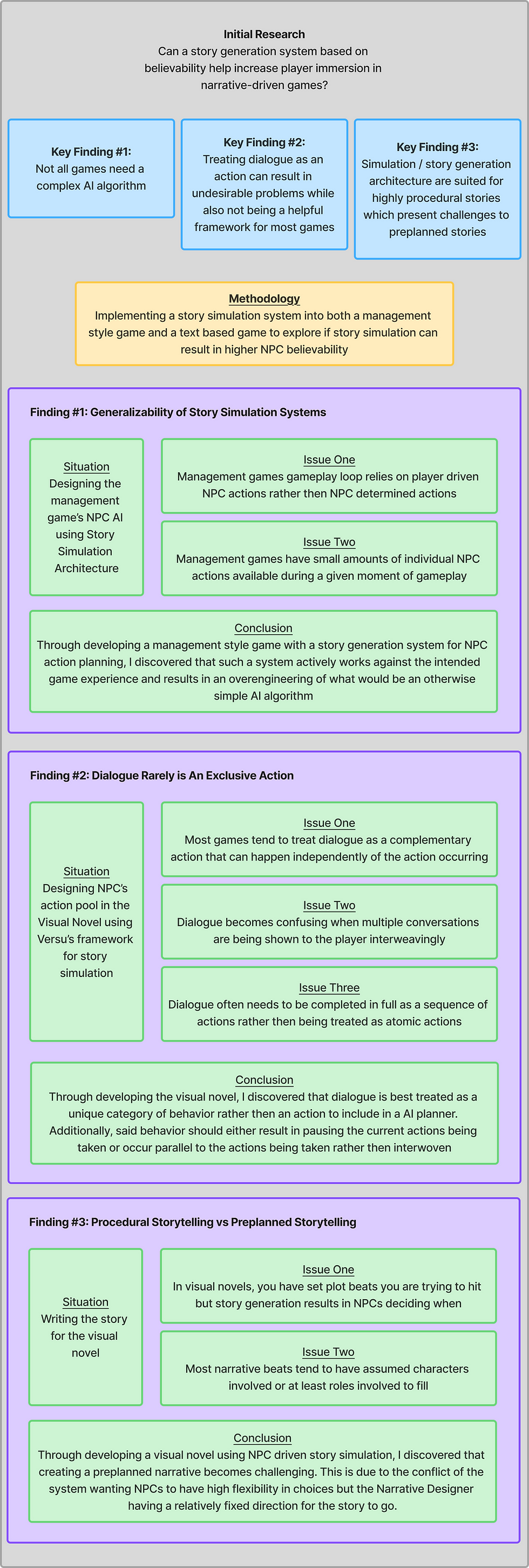
To start with, if you have multiple overlapping practices, you could result in an unclear scene since you don’t expect the story to be jumping back and forth between two storylines without rhyme or reason. Additionally, if a character is in multiple practices, then they can end up taking their actions in incoherent ways. Lets take the example I am working with right now, the practice of being in conversation with your friend and being in a duel. Now, one would expect that, while dueling, you would not be having a casual conversation with your friend. Yet, there lies the issue. Since multiple practices can be occurring simultaneously, you need to take that into account. However, that means you would need to either
Setup a system to kick yourself out of unrelated practices
Setup a system to “suspend” practice choices while a certain practice is going on
Setup a lot of preconditions to check for any of the superior practices.
However, each of these end up with the issue of (1) priorities and (2) nested code. Let me break that down a little better. By priorities, I mean that you need to have a system to determine which practices should have higher priority. For example, it's easy to see that a conversation with your friend should have less priority than a duel to the death. But what about the death of a friend? Which should have a higher priority, seeing / reacting to your friend's death or fighting for your own? Well then that gets into context, which means it's a lot harder to create a generalized solution for this issue.
Then we have issue (2) of nested code. This one is nasty in that you need to be aware of other social practices to have contingencies. For example, if you want to prevent your conversation from taking priority over your duel, then you will need to add in the prerequisite of dueling which means we have to sacrifice some of our flexibility since we can’t just create these two practices in isolation anymore.
Now, originally, I had thought this would only be an issue when dialogue was involved since it would obviously get confusing if you have two conversations happening simultaneously. Yet, we can now see that this is also an issue with dialogue + scene actions, since some dialogue should not be said when you're trying to stab someone. But, this actually even more of an issue since this also appeared with scene actions + scene actions. Why? Well when you're in an empty street, you would have several objects you can look at, yet when you're in a duel, you should not be taking the action “look at wall”.
Now some of these issues likely could be resolved with a desire system, but it's quite clear, because of the above issues, that this will likely result in problems. Additionally, I’ve been having a hard time determining what desires should be put into place without it becoming essentially an overly complex behaviour tree.
Yet, that’s not all. Another large issue is that the Versu system does not match traditional narrative structures. Specifically, since it's all character driven, the events can occur in any order which is super cool and novel, but you do need to sometimes hit plot beats in a certain order / pacing. Now this is usually where the argument is to be made about it being an emergent story but well the issue is that then leads to wanting to create a scene that is a playground not a structured narrative. Thus, that means I don’t think converting a story like Romeo and Juliet is honestly going to work that well.
Thus, I am now left at the crossroads of two paths:
Creating a play area with Versu to explore using it for emergent narratives with loose narrative structures
Exploring an alternate approach to having a story simulation while still aiming to have narrative structure to some extent
So my next steps will be to talk to my advisor about this and determine what should be our next course of action.
Project: Theatre
So moving along to Project: Theatre, where are we at? Well the good news is that I officially have a playable build of the game! You can find it here under the theatre module. Soon I’ll make a dedicated webpage for builds of the game but this works for now. Now the bad news is, it's only a sequence of placeholders that need to now be implemented and flushed out. Luckily this is about where I planned to be on my schedule but does mean that my next steps will need to be balancing and making the game fun.
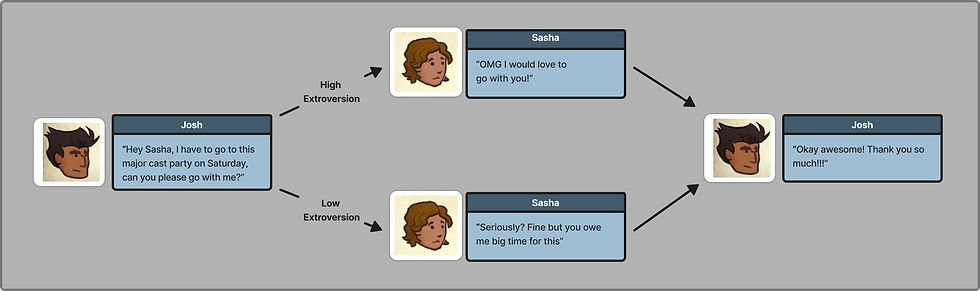
So then, where does that put the story gen system? Well I’ve still continued to make progress in that direction and have been working with Rae in our planning of the next steps. Essentially, we are planning to use a storylet based approach to have fun narrative events that will use a novel (I think?) approach of a salience-based dialogue system centered around roles and personality (using a big 5 personality model). This was inspired by a combination of Johnson-Bey (2025)’s storylet system, with Short (2016)’s writings on salience based models and Ortony (2003)’s proposed solution to use the Big 5 traits as personality categories. Ideally, this will give the flexibility of creating reusable narrative cards that still maintain the NPCs personality within the scene.
To implement this, I’ve been going through and creating placeholder spots for where we need certain narrative events and then Rae will go through and write the storylets and I will then create the salience system to handle the branching path ways.
Additionally, I’m going to be treating the storygen system as essentially an AI behaviour system to select what action will be taken if no action is assigned to them. But this won’t be added to after we get the base foundation of the rehearsal system made.
So yeah, progress has been made although there is still plenty of work left to do.
Believability Study
This week, I went through and touched up the questions that we will be using for the study. Additionally, I worked with Dr. Lynch on providing here GRA’s with a series of videos they can use for reference stimuli before the GRA’s go out looking for more stimuli.
The next steps will now be to review the stimuli and provide the feedback Dr. Lynch gave me regardings my questions.
Conclusion
Overall, while not the most amount of work I’ve accomplished in a week, I’m still pretty proud of some of the discoveries I was able to make. Now that most of my assignments have been completed in my other classes, I hope that this next week I’ll have more time to dedicate to my thesis research. With that, I think I shall wrap up this week's updates there.
Until next week, logging out.
Citations
Johnson-Bey, S., Liao, K., Shields, S., Hwang, D., Wardrip-Fruin, N., Mateas, M., & Melcer, E. (2025). Building Visual Novels with Social Simulation and Storylets. In J. T. Murray & M. C. Reyes (Eds.), Interactive Storytelling (Vol. 15468, pp. 145–161). Springer Nature Switzerland. https://doi.org/10.1007/978-3-031-78450-7_9
Ortony, A. (2003). On Making Believable Emotional Agents Believable. In R. Trappl, P. Petta, & S. Payr (Eds.), Emotions in Humans and Artifacts (pp. 189–212). The MIT Press. https://doi.org/10.7551/mitpress/2705.003.0007
Short, E. (2016, April 12). Beyond Branching: Quality-Based, Salience-Based, and Waypoint Narrative Structures. Emily Short’s Interactive Storytelling. https://emshort.blog/2016/04/12/beyond-branching-quality-based-and-salience-based-narrative-structures/

Comments