Prelude

In the following post, I discuss this week's steps towards reaching my thesis. Most were simply finishing setting up for what will hopefully be the dawn before the next large research push.
Introduction
Phew another week goes by, and quite a stressful one at that. Sometimes life goes your way and sometimes it doesn’t. But regardless of the situation one finds themself in, we continue to take steps forwards to what is yet to come. So let's see where those steps led this week.
The Story Gen Engine
Beginning at the top, what has happened this week with the StoryGen Engine? Well this week was once again another step into further refining what the StoryGen engine is. Using the diagrams from last time, I went off and sought out the advice of my thesis committee member, Yvette, to see if she could give me any guidance on improving my visualizations. An hour conversation and four pages of notes later, I walked away with a far better understanding of how to approach doing visual design. Below you can see the new and improved system diagram.

So in addition to the progress on my visuals, I’ve also spent some time looking deeper into a concept called Storylets. Essentially, they are chunks of narrative content that have prerequisites for when they should be shown and post conditions for what happens after they are shown. If you're like, ‘hmm that sounds familiar’ it's because Versu actually implements a type of Storylets for its social quip system. So then why look into them? Well, I’ve been going through creating a simple prototype game called Capulet which will be a generated-narrative style visual novel to explore the StoryGen engine. However, when I was going to implement the dialogue, it occurred to me that this seemed like it was very inefficient since each line of dialogue was its own snippet. Yet, I needed some more structured styles of writing. So then I recalled a paper on storylets in visual novels (Johnson-Bey et al. 2025) and decided to look further into its sources to see if I could find inspiration which led me to one of my favorite scholars, Emily Short. From there I went through looking into some of her writings on the topic for inspiration. So now I have a new plan, to essentially weave in and out of traditional branching narrative structures with contextual variations and the social quip system from Versu. Thus, next week I’ll be exploring implementing that into Capulets.
Project: Theatre
Okay well how did progress go this week for Project: Theatre? Well last week I had the following tasks:
Expand the prototype
Well that sure sounds simple, so then how did it go? Well, let's just say I spent A LOT of time in Figma this week. Why? Well, I decided to take the advice of one of my peers to use an actual UI tool instead of trying to implement it straight into Unity. Thus, I was going through and mocking up each of the low-fi versions of the menus in the game in order to work towards creating the first draft of the alpha levels. Below you can see a couple of these drafts.
From there, I then went through and implemented them into the game with a simple state-machine style approach for handling the gameflow. So where am I at now? Well I would say we now have about 75% of the first draft done with the last quarter being the fun part, Rehearsal. Why is that fun? Well that happens to also be the StoryGen aspect. So now I finally get to see the big question, will StoryGen help with the game? If not then this may quickly become a moment of large pivoting.
However, I still have a fair amount of confidence that it will work.
In any case however, this does mean I am still on track with my schedule for finishing the first drafts this week. Hopefully, that will also mean I’ll have the first build to share. So yeah, that's been most of the updates this week. As far as next week is concerned, my goal is to just finish the first draft so that the real heart of my research can begin, iteration and refinement.
Believability Study
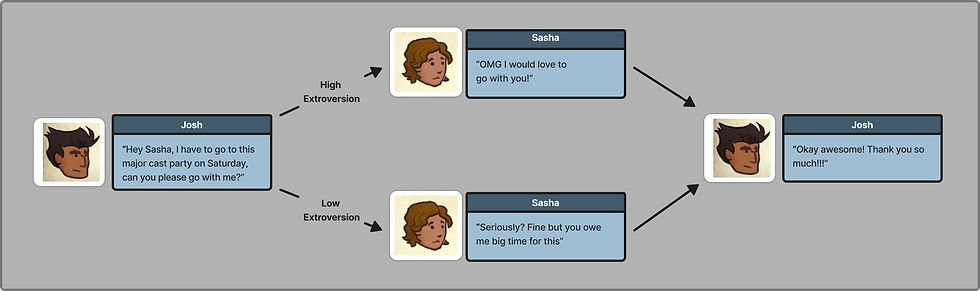
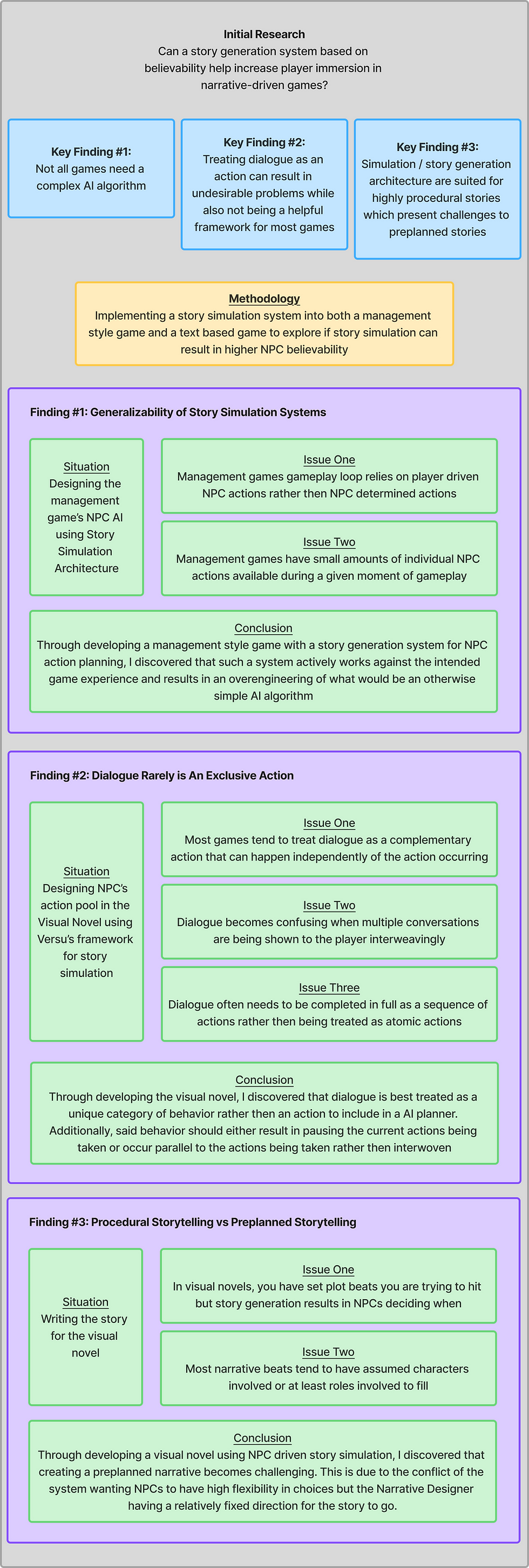
Okay, so the biggest updates this week were that I spent some time refining with my project lead, Teresa, the believability metric. We managed to work towards the next draft of visualizing the field of believability for NPCs (with some help from the lesson I had been given by Yvette) and then went through and updated my study questions. Below you can see our new working diagram.

So next week seems like it's going to be the official kickoff of the study. Or more specifically, preparing for the study. So time to start refining the questions further and looking for stimuli to give participants.
Conclusion
Okay this time kept it relatively short since last week was, a lot, to say the least. Hopefully you’ve enjoyed the latest installment in my journey towards making NPCs believable. With that, I believe it is time to call it a night.
Logging out.
Citations
Short, E. (2019, November 29). Storylets: You Want Them. https://emshort.blog/2019/11/29/storylets-you-want-them/
Johnson-Bey, S., Liao, K., Shields, S., Hwang, D., Wardrip-Fruin, N., Mateas, M., & Melcer, E. (2025). Building Visual Novels with Social Simulation and Storylets. In J. T. Murray & M. C. Reyes (Eds.), Interactive Storytelling (Vol. 15468, pp. 145–161). Springer Nature Switzerland. https://doi.org/10.1007/978-3-031-78450-7_9
Kreminski, M., & Wardrip-Fruin, N. (2018). Sketching a Map of the Storylets Design Space. In R. Rouse, H. Koenitz, & M. Haahr (Eds.), Interactive Storytelling (Vol. 11318, pp. 160–164). Springer International Publishing. https://doi.org/10.1007/978-3-030-04028-4_14

Comments