Reflection

This week, I spent some time thinking upon the results of some playtesting and altered my game in response. Additionally, I began preparing to submit to an abstract competition and continued my lit review.
Research Through Design
Hayes Form Submission
Since my last update, I’ve begun preparing Project Conversation: RoboCat for submission into my first public showcase related to my thesis. More specifically, The Ohio State University’s Hayes Form where graduate and doctoral students can submit an abstract and then, if accepted, compete in an abstract presentation competition judged by faculty across the university. My abstract is specifically related to the creation of my gossip system with some allusions to the social media and story engine. In the future, I hope to submit a more complete showcase of my work on the project but for this showcase I decided to make it more pin pointed.
Social Media System V1.1
Since my last entry, I’ve begun conducting playtesting session of the social media system and determined a few week points:
There was information overload due to the UI conveying the posts as a wall of text.
It was hard to keep track who was who
The UI presentation left room to be desired due to not being the most intuitive to navigate nor use
There was a fair bit of repetition of the gossip responses being used
Difficulty tracking related posts
Based on each of these critiques I’ve begun to reflect and iterate on improving the social media system to address these areas. More specifically I’ve come to the following questions, conclusions, and / or solutions
Preventing the feeling of a wall of text
Why does it feel like a wall of text? Does the page need restructuring? What alternative layouts could I consider?
The feeling of a wall of text was occurring due to how cramped together the posts felt and how little of the screen I was using for the main area of text. Additionally, the posts felt like one big block of text rather than individual snippets of text causing players to be overwhelmed.
To improve this, I needed to provide more empty space to make it feel like there is less text. Additionally, give each post a more distinct feel through additional separation to make it more approachable
Tracking who was who
What can be used to make NPCs more distinct within the social media app? What aids can be given to the player for them to be able to know who was speaking?
The feeling that each NPC is the same is resulting from the rather generic style and lack of personality being given to any single character. Additionally, the characters are all being introduced to the player at once not giving them time to acclimate to who is who. Additionally, very few indicators were being presented to assist the player in differentiating the characters.
To improve this, I’ve begun redesigning some of the elements to allow for more distinct personalities and characters to shine through. My first solution was to add in an additional users section that would allow players to view profiles of the characters as well as a dictionary they could reference to remember who were active characters. Second was to narrow down the cast of NPCs for our short gameplay experience to allow players to not have as many characters to keep track of. Finally, the reply page was redesigned from the initial barebones prototype to now provide more visual indicators of who made the post and who made the replies. In the future, I may also add color indicators to further distinguish the different characters by providing each with their own text color similar to Afterparty.
The UI Presentation
Why wasn’t the UI intuitive? What type of style should the UI be? How do other social media sites handle their UI?
To assist with the UI’s feel, in addition to the changes from above, the UI now has updated art designed by a fellow grad student named Sophia Reeder who agreed to help give the app a more stylized look. Additionally, the apps cover screen and posts screens were redesigned and the original feature of a friends section was replaced with the Users section. Finally, the recent posts now each contain an indicator for read status and the posts maintain their scroll bar position when returning back from the replies page.
Repetition in Replies
How many replies does a given NPC need? How many should be generic? How many should be specific? How many replies should be made per post? Is it better to repeat a reply or to not have a reply? How many references to the post should a reply have?
These are still ongoing questions that need further reflection.
Tracking Post Storylines
Is it better to present posts in related threads or in chronological order? How similar to a social media site should this system be in appearance?
Currently, no solution has been found to this problem.
Below you can see before and after shots from the Social Media System
Story Engine
The story engine has continued to be refined. New additions include:
The ability for NPCs to now have goals to pursue
The ability to track the relationships between NPCs
The ability to add requirements (relationship level and personality tags) and post results to actions
Additionally the following questions have been raised through my research
Is it better to define these through scripting, through JSON files, through databases, or through a custom tool?
Scripting allows for developers proficient in C# to have large amounts of customizability, however it is not easy to manage when the amount of options gets larger
JSON files still allow for a great deal of flexibility and slightly more better management for larger amounts of behaviours but still requires some technical knowledge
Excel Databases present the easy implementation and strongest organizational / management capabilities but are far harder to allow for customization since each attribute needs its own column and may result in empty columns. A more complex solution could be built with linking data structures for better database management but could also get cumbersome
The custom tool route could be the best of both worlds but would need development time. Yet that may be the best long term solution and should be considered for the future.
Generic Actions but Unique Voice
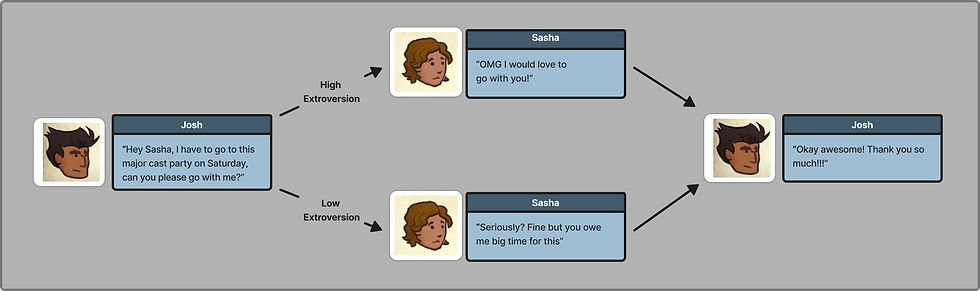
So the current solution requires events to be prewritten with the generated text such as “poured water on {target}” but that leaves less room for unique traits to come out. For example one character may instead “spill water on {target}” because they are clumsy or “poured alcohol on {target}” because water was inaccessible. A potential solution could be the personality tags mentioned above but would require large amounts of additional variations to be written, a more dynamic solution would probably be preferred. Additionally, having more elements could be interesting such as {tool} but would require additional development time to consider how it can be used. But this should be considered for the future.
TLDR: Need a dynamic personality modifier and a method to add additional properties to an event to make them more generic / flexible.
How best to create these actions?
Scene Type First
In this approach, you would consider what scenes an NPC could be in and then determine what the affordances of said scene are. Then determine variations for personality and relationship types to expand it.
Ex. Bar => Drink.
Drink => Share a drink, Buy a drink for, Challenge to a drinking competition
Drink => Slurp, Guzzle, Sip, Gulp
Personality First
In this approach, you would consider the types of NPCs you could have and then try to create actions related to the personality. Then add variations.
Ex. Aggressive => Fight
Fight => Dance of on the dance floor, Smash a bottle on a customer at the bar, Get up in the face of a person in the lounge
Fight => Protect, Challenge to a brawl, Suckerpunched
Relationship First
In this approach you would consider the types of NPC bonds that you could have and then build from there
Ex. Friends => Help
Help => Showed X some moves on the dance floor, Bought Y a drink, Gave Z some advice on flirting while chatting in the lounge
Help => Fought alongside X, Resolved a tense situation between Y and some hooligans, Kept Z company while everyone else was dancing
Overall, I don’t yet know the best approach to handle writing but these are at least a few to consider.
Priority Comparisons
As I’m building up my goal solution, it now presents the issue of deciding how to prioritize different actions. Should you choose one more related to location or to personality? Should you pursue plotline A or plotline B?
Don’t yet have a solution but one to further explore
Overall, thanks to using an iterative approach, the solution is now starting to raise some interesting questions about narratives and how to approach them. Yet, I can’t say I’m not proud of how far my system has come. There is now beginning to be a small illusion of life which is amazing to see. And yet more work is still left to be done.
Other Systems
Additional features unrelated to thesis:
Chat history to view past conversations
Updated dialogue boxes
Audio for gameplay using Pixabay
Lingering Questions
How many replies does a given NPC need? How many should be generic? How many should be specific? How many replies should be made per post? Is it better to repeat a reply or to not have a reply? How many references to the post should a reply have?
What is the best approach to writing generative stories?
Is it better to present posts in related threads or in chronological order? How similar to a social media site should this system be in appearance?
As I’m building up my goal solution, it now presents the issue of deciding how to prioritize different actions. Should you choose one more related to location or to personality? Should you pursue plotline A or plotline B?
New Art Style and Layout
Literature Review
Game Design Research: An Introduction to Theory and Practice
Chapter 1 - Epistemological Underpinnings of Game Design Research
In this chapter, Laureline Chiapello describes the history of Design Research and the way that games research has mimicked it. The following phases were discussed
Design as an Applied Art
Definition: Viewing design as a form of art which was based on intuition rather than focusing on what goes into the actual process
Examples: Reflections of a master game designer (Crawford, 1984) and The art of game design: A book of lenses (Shell, 2008).
Quote: “Look within your heart, long and hard. If deep down inside you know that you met your goals, then ignore the critics and the public” (Crawford, 1984, p.55)
Design as an Applied Aesthetic
Definition: Designers are artists but still have techniques and skills that they use, while intuition plays a role, one must also be trained and skilled to utilize that intuition
Examples: Rules of Play (Salen and Zimmerman, 2003) and Reflections of a master game designer (Crawford, 1984)
Quote: “A scientific conception of art sufficiently developed to constitute the theoretical framework from which the formal properties of the object will be rationally deduced” (Findeli and Bousbaci, 2005, p.8, our translation)
Design as an Applied Science
Definition: Viewing design as a problem solving field removed from intuition and that can be distilled into fundamental elements heavily based in a Positivist view
Examples: A Theory of Fun (Koster, 2018), Game Design Workshop (Fullerton, 2008) and Rational Design Handbook (McMillan, 2003)
Quote: “A way of objectively quantifying elements of user experience in order to create a consistent game play experience” (McMillan, 2013, p.1)
Design as a Reflective Practice
Definition: Viewing knowledge as something implicitly known to the designer that they build upon through reflection and reevaluation
Examples: 21st Century Game Design (Bateman and Boon, 2005), Level Up! (Rogers, 2010), Challenges for Game Designers (Brathwaite and Shreiber, 2009), and Game Design Workshop (Fullerton 2008)
Quote: “There are lots of books about video game design, but most of them are full of THEORY, which I have never found very helpful while making a game. Don’t get me wrong, theory is great when you are at a game developers’ conference or one of those wine and cheese affairs we game designers always find ourselves at.” (Rogers, 2010, p.xix)
While design research has shifted to (4), games still however lie in a muddled state between the four. As a result, the author argues that future researchers should better define the lens they are approaching from.
Chris Crawford: Chapter 7 - Simple Strategies that Don’t Work
In this chapter, Crawford (2004) presents an argument that interactive storytelling told through branching narratives provides too little choice for the player given the large amount of work required to pull off. Additionally, he critiques several variations designers have made to solve this issue such as fold-back schemes where it returns to a single story thread, constipated stories where the game alternates between gameplay and cutscenes, kill-em-if-they-stray which kills players in certain routes to minimize branches, and storified games which is combining games and stories together without proper consideration. Overall, an interesting read but potentially pretty outdated from where games have gotten to in past years.
A Gossip Virtual Social Network for Non Playable Characters in Role Play Games
In this paper, Perrie and Li give a great example of a gossip system implementation in game and a subsequent evaluation of the system. Unlike my system, there’s is more central to the gameplay acting as a way of helping the player achieve their goal. They used the following steps to transmit information
Contact
Observation - determine if info should be shared
Introvert vs extrovert
Gender
Age
Social Class
Race
Status - Do they know anything that the other does not?
A flag of agree / disagree for each
Social inventory of tracked information
Relationships - What is the bond between two characters
They also had a memory system that could allow for
Memory decay
Loss of memory
Strengthening memory
Permanent memories
They then evaluated its ability to share information quantitatively and then used qualitative methods through survey to see if players felt the system worked and would like to see more games used it. In both cases a positive outcome was achieved.
Paradise: An Experiment Extending the Ensemble Social Physics Engine with Language Models
In this paper, Kelly et al. 2024 presents the team's findings in trying to combine the ensemble engine with language models. Overall, it was a failure due to the large amount of complexity it resulted in when trying to modify it. Additionally, several critiques of using a prebuilt system were mentioned. Overall, it presents an interesting example of when research goes wrong.
GDC and Other Conference Talks
AdvX 2018 - Jon Ingold - Sparkling Dialogue: A Masterclass
Overall, this is one of the most informative talks I’ve listened to regarding the subject of writing dialogue in games and choices in said dialogue. Starting from the premise of game dialogue, which often is poorly written due to a lack of subtext, Jon Ingold goes through and outlines his solution to writing choices based on sharing subtext while offering different variations. One of his core goals is to have conversations maintain the same type of structure and flow as can be found in blockbuster Hollywood movies.
Some of my takeaways included:
If in doubt, have three choices
Accept, Go with the conversation
Reject, React against the current conversation
Deflect, Change to a different conversation
Loops result in slowness
You can make a scene into a battle by forcing the topic regardless of player choice
Flourishes:
Prevent the continuity problem of knowing stuff they shouldn’t
Add callbacks to previous choices
Alter choices in certain orders to make lines better suit context
Core Values
Activity
Agency
Responsiveness
Momentum
The Burden of Proof: Narrative Deduction Mechanics for Detective Games
In this talk, Jon Ingold talks about writing for Overboard, a narrative detective game where you are the killer trying to get away with murder.
Some takeaways were:
The deduction mechanic of Fact 1 + Fact 2 = Exciting new Fact 3 is very problematic
Many detective games gameplay loop mechanic are very hard to reproduce; Her story, return of the obra dinn, Outer wilds
Solution to detective game, make it centered around the big solve
Setup of accusation
Accusation scene begins
Player attempts to tilt the accusation scene
An ending is created
Inkle Approach to IF: Create a sensible default first and then add in overrides after
Two ways IF fails:
Run out of choices to say
Story doesn’t make sense
Further Up and Further In: Making Richer Gameplay Narratives
Built around the quote “My definition of good literature is that which can be read by an educated reader and reread with increased pleasure” by Gene Wolfe, Jon Ingold provides audience members with his philosophy on writing narrative games that can be replayed.
A few takeaways include:
Narrative games are often not replayable and more one off payoff
The best tool for good game dialogue is barks.
Barks are
Embedded
Characterful
Plentiful thus can be specific and varied
Contextual
Reactive
Pacing-focused
Cutscenes break the player connection to the protagonist because you just watch the character
Think of dialogue as argument simulators
Building Game Mechanics to Elevate Narrative in Oxenfree
In direct opposition to the trend of having mechanics driven encounters leading to story beats, Sean Krankel provides a case for having the two be combined based on the success of Night School Studios’ game Oxenfree. In particular, they provide the argument that dialogue should be viewed as an ability, not a choice menu and to not make choices be either good or bad. Key insights included:
Ask players what choice they would have wanted to say in a dialogue
Never have player character say something without the player’s input
Start with a pre-mortem, consider everything that could go wrong and plan how you will address those issues.
The Wrap Up
Overall, a lot of reflecting was able to be done which fit well with the approach I’m shifting towards in my thesis research.
Work Cited
Crawford, C. (2004). Chris Crawford on interactive storytelling. New Riders Games.
Kelly, J., Mateas, M., & Wardrip-Fruin, N. (2024). Paradise: An Experiment Extending the Ensemble Social Physics Engine with Language Models. Proceedings of the 19th International Conference on the Foundations of Digital Games, 1–4. https://doi.org/10.1145/3649921.3659841
Lankoski, P., & Holopainen, J. (2018). Game design research: An introduction to theory & practice. ETC Press.
Perrie, J., & Li, L. (2013). A Gossip Virtual Social Network for Non Playable Characters in Role Play Games. 2013 International Conference on Cyberworlds, 151–158. https://doi.org/10.1109/CW.2013.17

Comments