A Fresh Start

In the following post, I discuss my four week progress review of Project: Theatre, the start of Project: R&J, and the updates to the thesis.
Introduction
This week has been eventful regarding my thesis. Specifically, as I mentioned last time, after experimenting with a simple prototype of the game using my system, I noticed several design flaws that would need addressing. After discussions with both my thesis partner and advisor, I’ve since decided that going in a new direction would likely be best. Specifically, I’ve decided to move away from the story simulation system towards a dialogue permutation system which varies dialogue based on the personality and relationships of a character. So without further ado, let's get into the details.
The Dialogue Permutation System
As you can see from the above, I’ve moved away from the name StoryGen to simply calling it the Dialogue Permutation System although I guess you could also call it DPS for short. Essentially the way it works is that it draws upon inspiration of traditional dialogue trees’ dialogue structure, salience based dialogue systems (Short 2016), the Praxis language from Versu, and Ortony (2003)’s writing on personality modeling. Specifically, it addresses thespian style problems where you don’t know the NPCs involved in a scene when it begins so you need to create a generic dialogue scene so that it can match any character. However, this can result in a loss of characterization as you can’t write to a specific character or a large amount of narrative burden as you need to write for every character permutation. Below I have diagramed an example of this type of situation.

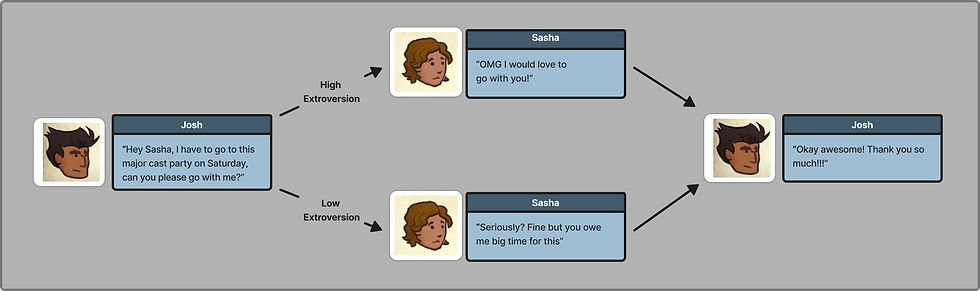
To address this issue, I’ve decided to create a simple permutation expansion of dialogue systems using the Twee format where you can specify variations for a role’s dialogue line that is changed based on if it meets the specified requirements. These requirements are modeled by the Praxis language so that they can have a wide range of complexity. Using this, one can then create minor dialogue permutations based on aspects such as personality or relationship status. To illustrate this I’ve created the following diagram scene below.

The reason that I’ve decided to take this approach is for a couple of reasons
This allows for familiar style of writing since you can treat it as the equivalent as writing branching dialogue which presents the illusion of choice through characterization which matches the skillset of the people who would use this type of solution
This causes for a large amount of different potential capabilities with relatively little complexity since through using the Praxis language, entire world states can be modeled and tracked very quickly and easily. Additionally, you could make branches both on the in text level or as branching to alternate node paths depending on the depth of variation needed
Based on my research on believability, the core aspects are a) personality, b) illusion of life, c) emotions, and d) relationships. Through this system all but c) can easily be addressed through modeling memories, personality, and relationships using the Praxis approach outlined in Versu’s writings.
Thus for these reasons, this seems like a fruitful path to wander down to see what new discoveries can be made. The next steps for this will be to incorporate a way to update the praxis world state through the dialogue to finish the circuit.
Project: R&J
To experiment with this approach of DPS, I’ve began creating a simple visual novel based off the story of Romeo and Juliet where you play as the role of Mercutio or the pacifist who is intertwined with all the other cast members but must act from the sidelines as the tragedy of the story enfolds. Through using this premise, it gives a narrative reason for why the player has less direct influence and must instead focus on shifting the direction of the story through choosing who to play each role and pushing the story into situations that will unfold in a fruitful way. Additionally, this allows me to explore the aspects I want to address using this system in a pure dialogue format making it very applicable and easily demoed. Finally, this helps evaluate how well this works across a continuous story with the same cast of characters to test its viability for those types of stories.
Project: Theatre
Meanwhile, to test the viability of the system to work with the same cast of characters but in various different roles in short form events, I am working on the management-style game Project: Theatre. Since I’ve talked about it extensively in past posts, I’ll keep this one brief. The biggest updates were incorporating this new system into the events and polishing up the first demo level with the rehearsal system for use in playtesting. Additionally, after presenting this to several of my peers, I was able to obtain a large amount of feedback regarding the UX of the game. This was accomplished using the playtesting method of not providing any instructions / guidance to the participant so as to see as natural of an interaction as possible and identify what issues would occur if someone were to use the game when I was not present. I’ve already incorporated several of those tweaks with the next biggest one being the inclusion of a tutorial.
In addition, I’ve now begun maintaining a list of each of the features in the game and their corresponding design reasons in order to provide clear documentation in my thesis for why each element was incorporated. Below you can see the current version of this list.
Label | Description | Reason |
Time | A time pressure system is incorporated within the rehearsal system. The timer lasts 3 minutes and is paused when in narrative scenes or assigning to events but not when looking at the environment map nor on a character assignment page. |
|
Casting NPCs | Instead of a fixed list of characters that will occur in the story and what roles they play in the story, the player instead is given the choice of casting the characters in whatever role they wish. |
|
Events (Static) | At fixed points within a rehearsal, an event will appear requiring the attention of the player and the player assigning 1-3 cast members to solve the issue. Each event has a set of skill requirements and a corresponding dialogue scene upon completion. |
|
Events (Dynamic) | When specific requirements are met during a rehearsal, an event will appear requiring the attention of the player and the player assigning 1-3 cast members to solve the issue. Each event has a set of skill requirements and a corresponding dialogue scene upon completion. |
|
Task Assignment | The player during rehearsal is given the task of looking at what needs to be completed both on an individual level and a production level and delegating cast members to complete those objectives. |
|
Full Game vs Single Level | The game is being designed to be a full 1-2 hour long narrative experience rather than a 20 minute prototype. |
|
Scoring System | The game scores the user based on the management of events, individual tasks, and production tasks. |
|
Calendar | The game occurs over the series of several days within a single month. Specifically, 11 different rehearsals plus the intro scene a few weeks prior. |
|
Character Customization | The game features the ability for the player to customize the character they are playing as. |
|
Tutorial | The game opens with a tutorial explaining the game mechanics to the player |
|
Twine Tool | The game makes use of the twine dialogue tool for creating both Rae and I’s thesis dialogue systems. |
|
Storylet Inclusion | The game features storylets based design as shown through the dynamic event system. Storylets are snippets of stories that have prerequisites for appearing and post conditions for modifying the world state upon completion. |
|
Personality Inclusion | The game features a dynamic narrative variation system during events where it will present minor variations based on the NPCs personality. The NPCs’ personality is based off the Big 5 Model of personalities |
|
Character Relationships | The game features a dynamic narrative variation system during events where it will present minor variations based on the NPC’s relationships. The NPCs’ relationships are tracked through state variables and past memories |
|
Day Time System | The game features a day time system in the style of traditional visual novels where players’ are able to bond with other members of the cast. |
|
9 Castable characters but 6 used | The game incorporates 9 different NPCs for which you can cast but only 6 of which you can cast. |
|
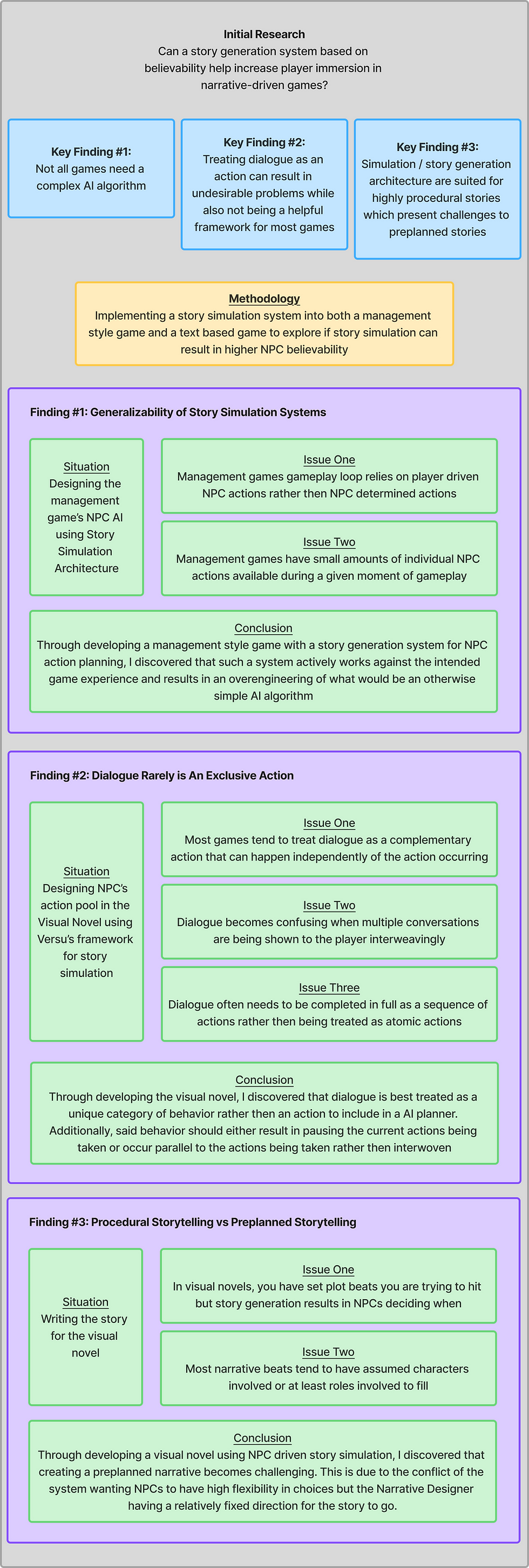
Overall, the next steps now is further refinement starting with the creation of a tutorial now that I’ve identified which aspects of the game are the most unintuitive to users. From there, I’ll work on expanding the content to include more events in the tutorial scene to further explore this solution across events. Finally, I’ll create a version of the game where it auto selects a set path for each character and then I will compare it to my system to see if my solution is providing an increase in characterization of the NPCs. This will be the first step in determining the usefulness of this approach. Below, I’ve included the four levels of success of the system which the goal to hopefully achieve a level equal to L3.

Believability Study
Finally, regarding the believability study, I’ve now gone through and created the third version of the believability questionnaire and have continued to look for more stimuli to give to participants. Apart from that, not much progress this week since the lead advisor was away this week at conferences.
Conclusion
Overall, I would say this was a very productive week in terms of progress. I’m looking forward to seeing where my thesis heads next.
Until next week, logging off.
Citations
Evans, R., & Short, E. (2014). Versu—A Simulationist Storytelling System. IEEE Transactions on Computational Intelligence and AI in Games, 6(2), 113–130. https://doi.org/10.1109/TCIAIG.2013.2287297
Ortony, A. (2003). On Making Believable Emotional Agents Believable. In R. Trappl, P. Petta, & S. Payr (Eds.), Emotions in Humans and Artifacts (pp. 189–212). The MIT Press. https://doi.org/10.7551/mitpress/2705.003.0007
Short, E. (2016, April 12). Beyond Branching: Quality-Based, Salience-Based, and Waypoint Narrative Structures. Emily Short’s Interactive Storytelling. https://emshort.blog/2016/04/12/beyond-branching-quality-based-and-salience-based-narrative-structures/

Comments