On Cooldown

This week, I began preparing for the second year review presentations and caught up on some projects that have fallen by the way side.
Introduction
With last week’s chaos now coming to a close, I’ve continued focusing this week on preparations for the upcoming second year review for my graduate cohort. In total, I’ll need to prepare a thesis proposal paper (which I wrote last week and reviewed with my advisor this week), a thesis project prototype (which is Role Call), an abbreviated presentation for the design faculty (which I wrote this week), and a full presentation for my committee (which will be next week’s project). In addition, I caught up on my studies in my other courses since the open house set me back in my side endeavors since I had shifted my focus squarely to Role Call. So with that, lets get into the updates.
Second Year Review Presentation
So for an update, my current thesis statement is that my research focuses on the creation of a dialogue permutation system (DPS) to maintain NPC believability when writing for a narrative scene in which the NPCs involved are unknown. To accomplish this, I am creating a three component thesis which is made up:
Project Conversations
Methodology: Iteration
A series of prototypes that are meant to explore both the use cases for DPS and create the process for which narrative designers can use the tool
Role Call
Methodology: Grounded Theory
A commercial game meant to explore the systems ability to integrate with long term projects as well as to observe another narrative designer, Rae, interacting with DPS
The Empirical Study
Methodology: Experimental study
A three way comparative study between two industry methods (no variation and per character variation) against DPS to analyze resulting immersion, perceived characterization, and perceived believability within the prototype of Role Call
As such, this thesis has the following goals
To develop a narrative tool that future designers can use to create believable NPCs in narrative driven games
To evaluate DPS against industry techniques to observe differences in player experiences when interacting with NPCs
To demonstrate how the concept of believability can be used as a framework to develop NPC narrative systems
For my presentation, I’m look to receive feedback on
What potential pitfalls or hurdles do you foresee occurring with the proposed thesis?
What improvements do you feel can be made to the proposal to strengthen its usefulness to designers?
What aspects of the proposal need to be better defined to be understood by practitioners?
For my presentation, I would like to have the criteria of
Clarity: How easy is it to understand the system being proposed and the problem being tackled?
Applicability: Does the proposed thesis have significance to the design field?
Design-Focused: Is the project clearly using a design approach?
I’m hoping to present this on a computer desktop in a quiet space.
The Dialogue Permutation System (DPS)
For this week, I’ve been primarily focused on creating some new diagrams / illustrations of my thesis project in preparation for the faculty presentation. Below are some of the diagrams. Additionally, I’ve now finished writing the first draft of the presentation which will be shown to my classmates on Wednesday. Apart from that, there are not many new additions to DPS.
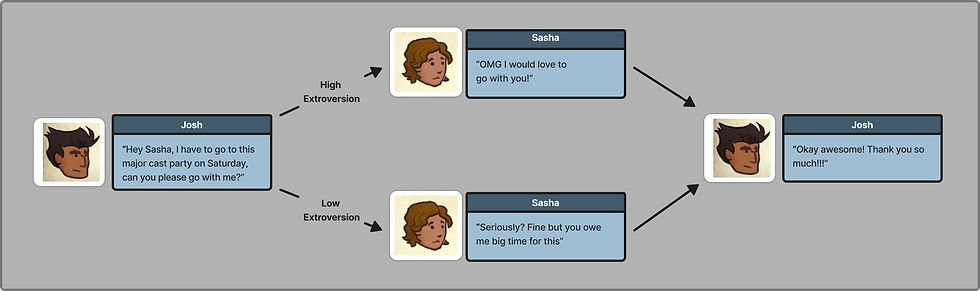
Figure 1: DPS Example

Figure 2: Breakdown of Methodology

Figure 3: Thesis Timeline

Figure 4: Skills developed through thesis

Figure 5: Thesis Coursework Breakdown
Role Call
After reviewing the feedback forms from open house, I went through and compiled a list of new additions / bug fixes that I have begun to work on cleaning. Below you can see the itemized list.
Compact the character view of the cast selection process
Make it clearer that the crew members completed their tasks
Clean up grammar
Improve the tutorial to require actions
Add drag and drop for event assignment
Add an indicator for when the cast member completes their current task
Bold trait words
Add ability to see peoples tasks when assigning to events
Make it clear when you have optional assignments (maybe dotted border to make it more clear
Add a pause screen
Make it easier to get a good score for the tutorial (more forgiving)
Add sfx on task completed
Make it clearer that you can assign multiple people to a task and add limits (maybe add a 0/4 indicator)
Maybe add a minigame to break up gameplay in management (like hacking game / choose which path)
Limit player name length
Add stats to character profile for character selection
Fix dialogue options not showing hover effect
Add an indicator for event length (short, medium, long)
Add unassign button for character selection
Add a visual effect for “juice” for input
Adjust sfx balancing
Backlog
Change background as rehearsal events occur
Add different name bubbles for dialogue
In addition, Rae and I spent some time planning the next steps for Role Call, which is deciding to push back our Vertical Slice till mid May so that we can focus on the upcoming second year review. Additionally, we ironed out more of the details of what the final game would look like and discussed some potential art styles to incorporate into the non-ui elements.
Believability Literature Review
With more time now that open house is over, I was able to shift over to working on my class project of beginning to write a literature review for how other scholars have approached defining, implementing, and evaluating believable NPCs in video games. This week I went through and compiled a list of approximately 800 papers based off a key word search in ACM and EBSCO and then went through and screened the papers to end up with about 100 approved papers and 57 maybe papers. The next steps will be to go through and tag each of the papers before turning it over to a second reviewer who will do likewise.
Conclusion
Overall, while this week was a little slower than the past, it was a much needed moment of respite as I head into this final stretch of my second year

Comments